



A Tenebrae service asks you to sit in the weight of what happened on Friday without rushing ahead to Sunday. Most church gatherings do not ask that of us.
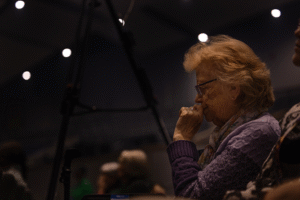 The room was somber from the start. This was not a service trying to inspire anyone in the usual way. It was asking us to remember and to feel the cost of what we were remembering.
Jon Ackerman, Richele Walker, and Brian Bales read from Scripture, tracing the final night and day: betrayal, trial, suffering, death. Hearing those familiar words read aloud in a darkened room, with no commentary or explanation, lands differently than reading them on the page.
The worship between readings matched the tone. There were laments and prayers, nothing triumphant. The songs were not trying to push people toward a feeling. They gave people room to stay with the one already in the room.
 As the service went on, candles were extinguished one by one. The room got darker, and the readings got heavier. Then came the sound of a hammer striking nails. You know what it is meant to represent. Even so, hearing it in a quiet room, surrounded by people you know, still lands hard.
After that came thunder, low and rolling, filling the sanctuary. Then came silence, not a pause, but the kind where no one moves. No resurrection yet. No empty tomb. Just a sealed stone.
Everyone walked out in that silence. There was no benediction, no closing remarks, no one talking in the lobby. People moved quietly through the doors and into the night, and no one had to be told.
 Tenebrae means “darkness” or “shadows.” We tend to want to skip ahead to Easter morning, but the church has always understood that Friday matters on its own terms. We have to sit with what it cost before the joy of Sunday means what it should.
If you were there, you know. If you were not, come next year.
Office Hours
M-T: 9:00a to 5:00p
F & S: Closed
Service Times
Sunday: In Person: 9:30a & 11:00a
Watch from Anywhere Online: 9:30 & 11:00a
CFCWired Monthly
Subscribe to our email newsletter to stay in the loop with everything happening at CFC
Download The App